The data storage industry is expanding at a faster rate. This is because organisations have huge amounts of data that they need to protect. Tape technology is still one of the most popular solutions for data archiving and backup. The current standard in this industry is the ninth generation of Linear Tape-Open. This technology provides unbelievable density for data centres and organisations. Read on to learn about its capacity.
What Is LTO-9 Tape?
LTO-9 is the newest industry standard for high-capacity magnetic tape storage. It provides a powerful solution for companies dealing with big data challenges. This generation builds upon years of proven mechanical and magnetic reliability. It is specifically designed to handle the massive backups required by modern digital enterprises. Many top hardware manufacturers provide this reliable technology for their customers.
You can look for quality options such as the IBM LTO 9 tape for your enterprise servers. These tapes use advanced tunnelling magnetoresistive head technology for better accuracy. The tape format is perfect for creating an air gap to safeguard against cyber attacks. It ensures that your most confidential data remains offline and out of reach of hackers. The use of a Dell LTO 9 tape will greatly enhance your overall data protection plan.
The core features of this technology include:
- High-density magnetic layers to store massive amounts of digital data
- Advanced hardware encryption to ensure the complete security of all archived data
- Long-lasting durability that enables tapes to last for up to thirty years
LTO-9 Tape Native Capacity
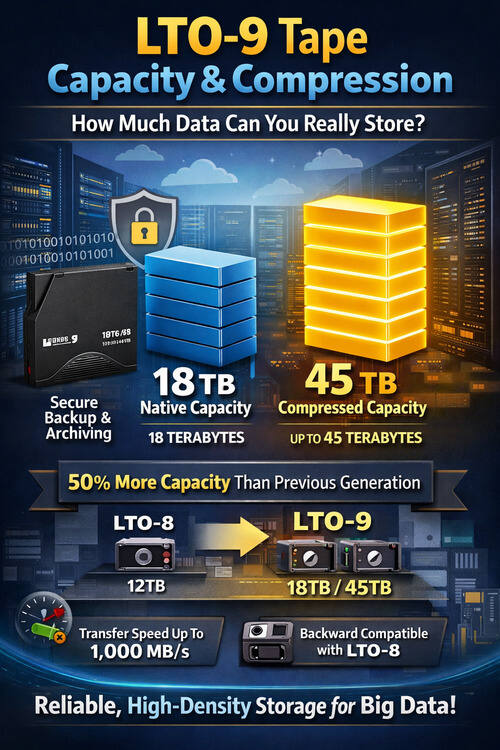
Native capacity is the amount of raw data that a tape can store. This value assumes that no software or hardware compression is being used. For this specific generation, the native limit is set at 18 terabytes. This is a massive jump from the previous generation of tape media. It allows users to store more information while using less physical shelf space.
A single HP LTO 9 tape can hold approximately 18 trillion bytes of raw data. This measurement is consistent across all certified manufacturers and hardware brands. Having such a high baseline capacity helps reduce the footprint of modern data centres. It also lowers the total cost of ownership for long-term storage needs. Smaller companies can now store their entire database on just a few cartridges.
LTO-9 Tape Compressed Capacity
Compressed capacity is the theoretical maximum amount of data a tape can store. This figure is calculated using a standard compression ratio of 2.5 to 1. For this generation, the advertised compressed limit is a massive 45 terabytes. This allows for incredibly efficient storage of text files and database logs. However, the actual results depend heavily on the specific files you are saving.
If you use an IBM LTO 9 tape, the hardware automatically manages the compression. The drive looks for patterns in the data to reduce its size. This process happens in real-time as the information moves to the magnetic ribbon. It does not slow down the transfer speed during the backup window.
The factors affecting the total compressed capacity are:
- Text documents and logs compress very well and save space
- Encrypted files or pre-compressed folders will not shrink any further
- Multimedia files like high definition video stay at their native size
Comparing LTO-9 with Previous Generations
Moving from older generations to the current one provides a major performance boost. This technology offers a 50% increase in capacity compared to the eighth generation. It also features a native transfer speed of 400 megabytes per second. When compression is active, speeds can reach up to 1,000 megabytes per second. This makes the HP LTO 9 tape much faster than older backup methods.
Compatibility is an important factor when upgrading your existing hardware library. These new drives can read and write to the previous generation of tapes. This ensures that you can still access your older archives without any trouble. Choosing a Dell LTO 9 tape ensures that you stay ahead of the technology curve. It provides the best balance of speed and long term reliability.
Conclusion
Understanding the difference between native and compressed capacity helps with storage planning. LTO-9 provides a massive 18 terabytes of raw space for any data type. With its compression ratio, you can achieve a maximum of 45TB per cartridge. This technology remains the most cost-effective way to store large datasets safely.
Investing in this format ensures your data survives for decades to come. Whether you prioritise raw speed or total volume, this generation delivers on all fronts. It effectively reduces data centre costs while providing superior protection against modern ransomware. Selecting the right media is the key to a successful long term archiving strategy.
Maximise your data security and storage capacity with KSG Automation Pvt. Ltd.’s best LTO-9 solutions. Contact us today for best prices!