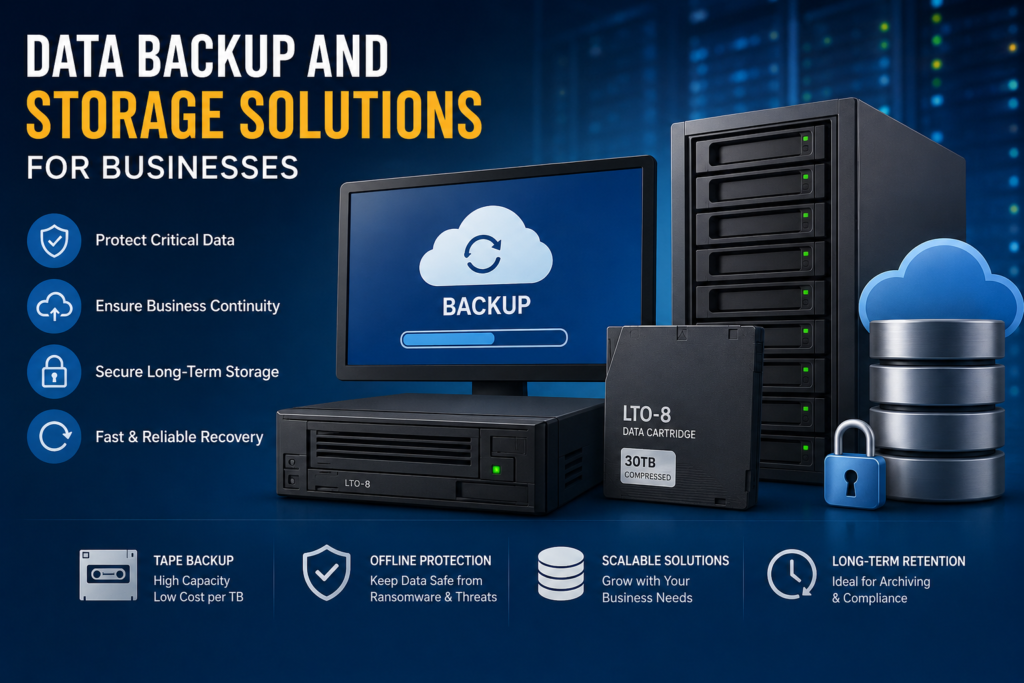
Businesses today depend on digital data for daily operations, customer information, financial records, applications, and important documents. Choosing the right backup and storage solution is therefore essential for protecting valuable information and maintaining business continuity. KSG Automation Pvt. Ltd. provides data-storage and backup-related products that can help organizations build a reliable and scalable data protection environment using tape, storage servers, and other technologies.
What Are Data Backup and Storage Solutions?
Data backup and storage solutions are technologies and processes used to store business information and maintain additional copies that can be recovered when required. Primary storage supports everyday business operations, while backup storage provides an additional layer of protection against data loss.
Depending on their requirements, businesses can use cloud storage, storage servers, disk-based systems, and tape-based storage. A combination of these technologies can provide a balance between accessibility, recovery speed, capacity, security, and long-term data retention.
Why Is Data Backup Important for Businesses?
Business data can become unavailable because of hardware failure, accidental deletion, software issues, cyber incidents, or unexpected system problems. Maintaining reliable backup copies helps organizations recover important information and reduce potential disruption.
Businesses should avoid depending on a single copy of important data. Multiple backup copies stored across different locations or technologies can provide greater resilience and support disaster recovery planning.
For organizations managing large datasets, tape backup can be a useful component of a broader data protection strategy because removable cartridges can be stored separately from the primary IT environment.
What Is a Backup Tape Drive?
A backup tape drive is a hardware device designed to read and write digital information on compatible magnetic tape cartridges. It is commonly used for enterprise backup, archival storage, disaster recovery, and long-term data retention.
During a backup operation, information is transferred from a server or storage system to the tape drive, where it is recorded onto a compatible cartridge. After the process is complete, the cartridge can be removed and stored securely according to the organization’s backup policy.
When selecting a tape drive, businesses should evaluate LTO generation, cartridge compatibility, capacity, transfer speed, interface, encryption capabilities, operating-system support, and backup software compatibility.
Why Is Tape Backup Useful for Businesses?
Tape backup can provide high-capacity removable storage for organizations that need long-term data retention. Since cartridges can be removed from the drive and stored separately, businesses can maintain an additional backup copy that is not continuously connected to their primary infrastructure.
This physical separation can be valuable when organizations want to strengthen their disaster recovery strategy. Tape is also suitable for information that needs to be preserved for extended periods but does not require continuous online access.
As part of its storage and backup portfolio, KSG Automation Pvt. Ltd. provides tape-related products and storage solutions designed for different business requirements.
Is HP LTO 8 Data Cartridge Suitable for Business Backup?
The HP LTO 8 Data Cartridge is designed for compatible LTO 8 tape-drive environments and can be used for enterprise backup, archival, and disaster recovery requirements. LTO 8 technology provides organizations with a high-capacity removable storage option for managing growing volumes of business information.
Before purchasing an LTO 8 cartridge, businesses should confirm compatibility with their existing tape drive and backup software. They should also evaluate their storage capacity, retention requirements, backup schedule, and future data growth.
The actual amount of data that can be stored may vary depending on whether data compression is available and how compressible the organization’s data is.
How Do Tape Drives and Data Cartridges Work Together?
A tape drive and a data cartridge perform different functions within a tape-storage system. The drive reads and writes information, while the cartridge contains the magnetic tape used to store the data.
For example, a business can keep active information on its storage server and periodically create additional backup copies on compatible tape media. Once the backup is completed, the cartridge can be removed and stored according to the organization’s retention and disaster recovery requirements.
For readers who want to understand the relationship between these technologies, What Is a Data Cartridge, Storage Server & Tape Drive? A Complete Guide to Tape Backup provides additional information about data cartridges, storage servers, tape drives, and their role in business data protection.
What Should Businesses Consider Before Choosing a Storage Solution?
Choosing a suitable storage and backup solution requires careful evaluation of current and future business requirements.
Storage Capacity
Businesses should estimate their current data volume and expected growth. The selected solution should provide sufficient capacity for regular backups and long-term retention.
Compatibility
Organizations should verify compatibility between their storage hardware, operating system, backup software, tape generation, and media before purchasing new equipment.
Recovery Requirements
Businesses should determine how quickly critical information needs to be restored. Frequently accessed operational data may require fast-access storage, while archival information can be stored on long-term media.
Security
Data security should be considered throughout the backup process. Encryption, access controls, secure media handling, and appropriate retention policies can help protect important business information.
Offline and Offsite Storage
Keeping selected backup copies offline or at a separate physical location can add another layer of protection against incidents affecting the primary IT environment.
Scalability
The storage solution should accommodate future data growth. Selecting a technology that can scale with business requirements can help reduce the need for frequent infrastructure changes.
Tape vs Cloud and Disk Storage
Cloud, disk, and tape technologies offer different advantages. Cloud storage can provide remote accessibility and flexible capacity, while disk-based backup can support quick access and recovery.
Tape can complement these technologies by providing removable, high-capacity storage for long-term retention. Instead of relying on one storage technology, businesses can create a layered approach in which primary data remains accessible while additional copies are maintained using different backup methods.
This approach can improve flexibility and help organizations establish a more comprehensive data protection strategy.
How Can Businesses Improve Their Backup Strategy?
An effective backup strategy requires regular planning and management rather than simply purchasing storage hardware. Businesses should establish a consistent backup schedule and define procedures for media handling, retention, restoration, and offsite storage.
Important practices include:
- Schedule regular backups.
- Maintain multiple copies of important data.
- Keep selected backup media offline.
- Consider secure offsite storage.
- Label and catalog backup cartridges.
- Follow a defined retention policy.
- Test data restoration regularly.
- Check hardware and media compatibility.
- Review storage requirements as data volumes increase.
Regular recovery testing is particularly important because businesses need to know that their backup data can actually be restored when required.
How Can LTO Storage Support Long-Term Data Retention?
LTO technology can be useful for organizations that need to retain large volumes of information for extended periods. Its removable media format allows businesses to store cartridges separately from their primary infrastructure.
Organizations evaluating an HP LTO 8 Data Cartridge should consider their existing LTO hardware, backup software, required capacity, data-retention period, and recovery objectives before selecting the media.
LTO storage can work alongside cloud and disk systems rather than replacing them. This makes it possible for businesses to create a layered storage architecture based on data importance and access requirements.
Choosing the Right Business Backup Solution
The best solution depends on the organization’s data volume, recovery objectives, budget, infrastructure, security requirements, and retention period. Businesses with large datasets may benefit from combining storage servers, cloud or disk-based backup, and removable tape media.
When selecting a backup tape drive, organizations should review LTO generation, capacity, transfer performance, connectivity, compatibility, and security features. They should also consider how the drive will integrate with their existing backup environment.
A well-planned combination of storage technologies can help businesses protect critical information while maintaining practical recovery and long-term archival capabilities.
Conclusion
The best data backup and storage solution is one that matches a business’s data volume, security requirements, recovery objectives, and long-term retention needs. Cloud, disk, storage servers, and tape backup can each serve different purposes within a comprehensive data protection strategy.
For organizations requiring high-capacity removable storage, LTO solutions can support backup, archival, and disaster recovery requirements. Proper compatibility checks, scheduled backups, secure storage, and regular restoration testing can make the overall strategy more reliable.
For suitable tape-storage and data backup solutions for your business requirements, Contact Us at KSG Automation Pvt. Ltd. and explore the right storage products for your organization’s needs.