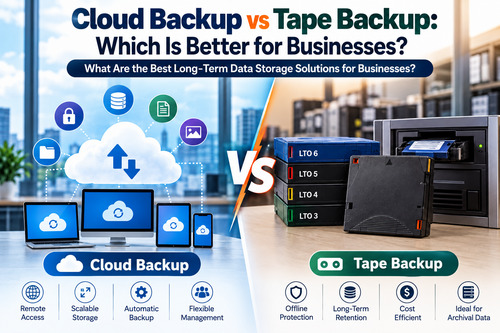
Businesses generate and manage large volumes of digital information, including customer records, financial files, databases, applications, emails, and project documents. To protect this valuable information, organizations need a reliable backup strategy, and tape backup can be one option for creating offline copies and supporting long-term data retention. Cloud backup is another widely used approach that provides remote accessibility and scalable storage. Understanding the differences between these technologies can help businesses develop a backup strategy based on their data, security, recovery, and retention requirements.
What Is Cloud Backup?
Cloud backup is a data-protection method in which business information is copied from local systems to remote cloud infrastructure. Depending on the service, backups can be scheduled automatically and managed through an online platform.
One of the main advantages of cloud backup is remote accessibility. Authorized users can manage backup data and initiate recovery processes through the provider’s platform, making cloud solutions useful for businesses with multiple offices, distributed teams, and remote infrastructure.
However, businesses should consider internet connectivity, recurring service costs, provider policies, security controls, recovery requirements, and data-retention policies before selecting a cloud backup service.
What Is Tape Backup?
Businesses need reliable methods to protect important files, databases, applications, and other digital information from accidental loss or system failure. One commonly used approach is tape backup, where business data is copied to magnetic tape cartridges through compatible tape drives for recovery, archival, disaster recovery, and long-term retention.
A major characteristic of this technology is that cartridges can be removed from the tape drive and stored separately from the production environment. This allows organizations to maintain offline copies of important data while following structured daily, weekly, monthly, or long-term retention policies.
What Is the Difference Between Cloud Backup and Tape Backup?
Cloud and tape backup use different methods to protect business information. Cloud backup generally focuses on remote accessibility, automation, and flexible capacity, while tape backup is commonly associated with removable media, offline storage, archival requirements, and long-term retention.
The appropriate solution depends on factors such as data volume, recovery objectives, retention requirements, network availability, security policies, and budget. Businesses can also combine both technologies instead of depending entirely on one backup method.
What Are the Benefits of LTO Tape for Businesses?
LTO technology is commonly used for enterprise backup and archival environments where businesses need removable media for storing large quantities of information.
For organizations operating compatible LTO 6 infrastructure, lto 6 tape can be used for backup and archival applications. Businesses should check the specifications of their existing tape drive before purchasing media because compatibility between the drive and cartridge generation is essential.
Tape media can also be stored separately from production systems, providing businesses with an additional offline copy that can form part of a broader data-protection strategy.
What Is HP LTO 6 Tape Used For?
Organizations using compatible HP LTO 6 tape-drive systems may use HP lto 6 tape for business data backup, archival storage, and long-term retention.
The appropriate tape media should always match the supported generation and capabilities of the tape drive. Businesses should also maintain proper media labeling and inventory records so that backup cartridges can be identified and retrieved efficiently when required.
For organizations maintaining an established LTO environment, using compatible media can help maintain consistency across their existing backup infrastructure.
What Is an HP LTO 6 Data Cartridge?
An HP lto 6 Data Cartridge is magnetic storage media designed for use with compatible LTO 6 tape-drive environments. Businesses can use suitable cartridges to store backup copies, archived information, and other data that needs to be retained for an extended period.
Effective cartridge management is an important part of tape-based storage. Organizations should maintain clear labels, inventory records, appropriate storage conditions, and retention schedules for different backup sets.
Before purchasing replacement media, businesses should confirm that the cartridge generation is supported by their specific tape-drive model.
What Is IBM LTO 5 Tape Used For?
An IBM lto 5 tape is magnetic storage media associated with the LTO 5 technology generation. It can be used with compatible LTO 5 tape drives for backup and archival purposes.
Businesses that continue to operate legacy LTO 5 infrastructure may still require compatible media for existing backup sets or archival requirements. Before using or purchasing older-generation media, organizations should verify the supported read and write capabilities of their particular tape drive.
Maintaining compatibility between the tape drive, cartridge, and backup software is essential for reliable data recovery.
Is Cloud Backup More Secure Than Tape Backup?
The security of a backup system depends on how it is designed, configured, accessed, and managed. Cloud backup services may provide security features such as encryption, authentication, access controls, monitoring, and permission management.
Tape provides a different security characteristic because cartridges can be physically removed from the backup environment. When stored offline, the media is not continuously connected to the network.
For this reason, businesses can consider maintaining both online and offline backup copies as part of a layered data-protection approach.
Can Businesses Use Cloud and Tape Backup Together?
Yes. Cloud and tape can be used together as complementary components of a business backup strategy.
For example, frequently accessed backup data can be maintained in cloud infrastructure for convenient remote recovery, while selected backup sets can be copied to tape for long-term archival and offline storage.
This hybrid approach allows organizations to assign different technologies to different types of information. Data requiring frequent recovery can remain readily accessible, while historical or rarely accessed information can be maintained using an appropriate archival solution.
Businesses interested in broader storage planning can also explore What Are the Best Long-Term Data Storage Solutions for Businesses? to understand different approaches to long-term data retention, backup, and secure storage.
How Should Businesses Choose a Backup Solution?
Before selecting cloud backup, tape backup, or a combination of both, businesses should evaluate several factors.
Data volume: Determine how much information needs to be protected today and how quickly storage requirements are expected to grow.
Recovery requirements: Identify how quickly different categories of information need to be restored following a system failure.
Retention period: Determine whether data needs to be retained for months, several years, or longer.
Network dependency: Cloud-based backup requires suitable connectivity for backup and recovery operations.
Security requirements: Evaluate encryption, authentication, access controls, offline copies, and physical security.
Budget: Compare infrastructure costs, media expenses, cloud subscriptions, maintenance, and operational requirements.
Compatibility: Businesses using tape technology should verify that selected cartridges are compatible with their existing tape drives.
Why Is Tape Backup Still Relevant for Businesses?
Cloud computing has changed the way many organizations manage their data, but physical backup media can still have an important role in long-term data protection. Businesses with large datasets may need offline copies, archival storage, and retention strategies that extend over several years.
Tape cartridges can be physically separated from production systems and stored according to organizational retention policies. This makes tape relevant for specific backup, archival, and disaster-recovery requirements.
KSG Automation Pvt. Ltd. provides storage and IT infrastructure products that can support businesses evaluating tape-based backup and data-storage requirements. Organizations can assess their existing infrastructure, media compatibility, capacity requirements, and retention policies before selecting an appropriate solution.
Building a Practical Data Protection Strategy
A comprehensive data-protection strategy does not necessarily have to depend on a single technology. Businesses can combine primary storage, cloud services, disk-based backup, and physical tape media according to their operational requirements.
For example, frequently accessed information can have readily available backup copies, while historical information can be maintained on suitable archival media. Businesses should also regularly test their backup and recovery processes to confirm that stored data can be restored when required.
By evaluating storage capacity, accessibility, security, recovery objectives, and retention requirements, organizations can develop a backup environment that supports both day-to-day operations and long-term data protection.
KSG Automation Pvt. Ltd. can help businesses explore suitable storage and backup products based on their infrastructure and data-management requirements.
Conclusion
Cloud backup and tape backup provide different approaches to protecting business information. Cloud solutions can offer remote accessibility and scalable infrastructure, while tape-based solutions can support offline storage, archival requirements, and long-term data retention.
Technologies such as lto 6 tape, HP lto 6 tape, HP lto 6 Data Cartridge, and IBM lto 5 tape can be relevant for organizations operating compatible LTO environments. Businesses should evaluate their data volume, recovery objectives, security requirements, retention policies, infrastructure, and budget before selecting a backup approach.
A combination of cloud and physical backup technologies can help organizations build a structured data-protection strategy. For storage media, tape backup products, and related IT infrastructure solutions, Contact Us KSG Automation Pvt. Ltd. to discuss your business requirements and explore suitable backup and storage solutions.