In today’s digital world, data security is no longer optional. Businesses store vast amounts of sensitive information on hard drives, SSDs, backup tapes, USB devices, and other storage media. When these devices reach the end of their lifecycle, simply deleting files or formatting drives is not enough to prevent data recovery.
This is why many organisations invest in a hard disk drive shredder to ensure complete and permanent destruction of confidential data. Whether you operate a corporate office, government agency, healthcare facility, financial institution, data center, or recycling business, choosing the right shredding equipment is essential for maintaining compliance and protecting sensitive information.
This guide explains the key factors to consider when selecting the best hard drive shredder for your organisation.
Why Hard Drive Destruction Matters
Many organisations mistakenly believe that deleting files permanently removes data. In reality, data can often be recovered using specialised software even after formatting a drive.
Improper disposal of storage devices can result in:
- Data breaches
- Identity theft
- Financial losses
- Regulatory penalties
- Damage to business reputation
A professional hard disk drive shredder physically destroys storage media, making data recovery virtually impossible.
Understanding Hard Drive Shredders
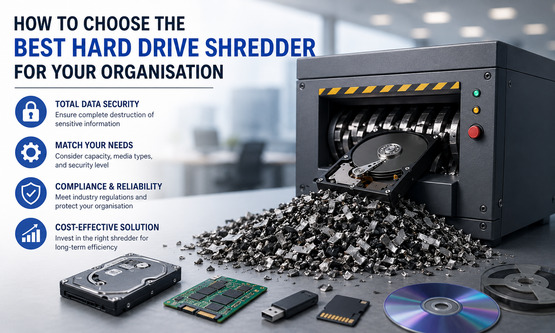
A hard drive shredder is a machine specifically designed to destroy storage devices by cutting, crushing, or shredding them into small pieces.
These machines are commonly used to destroy:
- Hard Disk Drives (HDDs)
- Solid State Drives (SSDs)
- Backup Tapes
- USB Flash Drives
- Memory Cards
- Optical Media
- Smartphones and Storage Components
Depending on security requirements, organisations may choose different shredding sizes and destruction methods.
Identify Your Organisation’s Security Requirements
Before purchasing a shredder, determine your data destruction needs.
Ask yourself:
- How many drives require destruction each month?
- What types of media need to be destroyed?
- Are there industry compliance requirements?
- Is on-site destruction necessary?
- What security level is required?
Organisations handling highly sensitive information often require smaller shred sizes to meet strict data destruction standards.
Choose the Right Shredding Capacity
One of the most important factors is shredding volume.
Low-Volume Organisations
Suitable for:
- Small businesses
- Schools
- Local offices
These organisations may only need occasional hard drive destruction and can use entry-level systems.
Medium-Volume Organisations
Suitable for:
- Corporate offices
- IT departments
- Financial institutions
These users require faster processing speeds and greater throughput.
High-Volume Operations
Suitable for:
- Data centers
- IT asset disposal companies
- Electronics recyclers
- Government agencies
Heavy-duty shredders provide continuous operation and higher destruction capacity.
Selecting a machine that matches your workload improves efficiency and reduces operating costs.
Consider the Types of Media You Need to Destroy
Many businesses require more than hard drive destruction.
This is where a multimedia shredder becomes valuable.
A multimedia shredder can destroy:
- Hard drives
- SSDs
- Backup tapes
- USB drives
- Mobile phones
- CDs and DVDs
- Memory cards
Instead of investing in multiple machines, organisations can use a single system to destroy various media types securely.
This flexibility often makes a multimedia shredder a cost-effective long-term solution.
Evaluate Security Levels
Not all shredders provide the same level of security.
The final particle size determines how difficult it is to recover data after destruction.
Higher security requirements generally require:
- Smaller particle sizes
- More aggressive shredding mechanisms
- Greater compliance capabilities
Industries such as government, defense, banking, healthcare, and data centers often require higher destruction standards than general commercial organisations.
When comparing models, always review the final shred size specifications.
Check Compliance Requirements
Many industries must comply with data protection regulations.
Examples include:
- GDPR
- HIPAA
- PCI DSS
- ISO Security Standards
- Government Data Disposal Policies
The best hard drive shredder should help your organisation meet relevant compliance requirements while providing documented proof of secure destruction.
Compliance is particularly important for organisations handling customer, financial, healthcare, or confidential government information.
Look for Operational Efficiency
A shredder should not only provide security but also improve operational efficiency.
Key features to consider include:
- Automatic feeding systems
- Continuous-duty operation
- High throughput capacity
- User-friendly controls
- Jam prevention technology
- Easy maintenance access
These features can significantly increase productivity, especially in environments where large quantities of media are destroyed regularly.
Prioritise Safety Features
Industrial shredding equipment should include adequate safety systems.
Look for features such as:
- Emergency stop buttons
- Safety sensors
- Automatic shutdown systems
- Overload protection
- Enclosed shredding chambers
Protecting employees is just as important as protecting data.
Consider Long-Term Operating Costs
The purchase price is only one part of the investment.
You should also evaluate:
- Maintenance requirements
- Spare parts availability
- Energy consumption
- Service support
- Machine lifespan
A lower-priced shredder may cost more over time if maintenance and repairs are frequent.
Organisations should focus on overall value rather than upfront cost alone.
Choose a Reliable Manufacturer
Not all shredding equipment offers the same level of reliability.
When evaluating suppliers, consider:
- Industry experience
- Product quality
- Customer reviews
- Technical support
- Warranty coverage
- Availability of replacement parts
Working with an established supplier can reduce downtime and ensure long-term performance.
Why Many Organisations Are Investing in Advanced Shredding Solutions
As cybersecurity risks continue to rise, organisations are becoming more proactive about data destruction. Modern businesses are no longer relying solely on software-based data wiping methods. Instead, they are investing in industrial-grade hard disk drive shredder and multimedia shredder solutions that provide complete physical destruction of storage devices.
For businesses handling sensitive information, investing in the best hard drive shredder can strengthen data security policies, improve compliance, and reduce the risk of data breaches.
Signs You Need the Best Hard Drive Shredder
Your organisation may benefit from upgrading its destruction equipment if:
- Large volumes of drives accumulate regularly
- Compliance requirements are increasing
- Outsourced destruction services are costly
- Data security risks are growing
- Multiple media types require destruction
Investing in the right equipment often improves both security and operational efficiency.
Final Thoughts
Choosing the best hard drive shredder requires more than simply comparing prices. Organisations must consider security requirements, media types, shredding capacity, compliance standards, operational efficiency, and long-term costs.
For businesses that handle multiple storage formats, a multimedia shredder can provide added flexibility and value. Meanwhile, organisations focused specifically on secure data destruction should prioritise a high-quality hard disk drive shredder that meets industry security standards.
At KSG Automation, we understand that secure data destruction is a critical part of modern information security. By selecting the right shredding solution, organisations can protect sensitive information, reduce compliance risks, and ensure complete data destruction throughout the lifecycle of their storage devices.