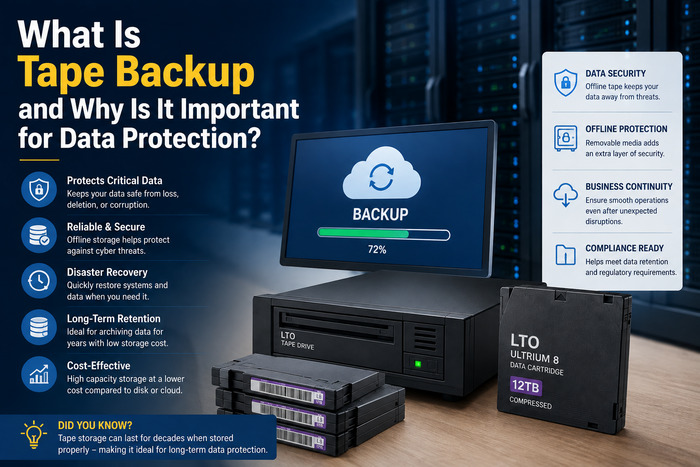
In today’s digital environment, businesses generate and manage large amounts of sensitive information, including customer records, financial data, applications, databases, and operational files. Protecting this information requires more than simply storing it on a primary server. A reliable tape backup strategy can create an additional copy of important data and support long-term retention, disaster recovery, and business continuity. As organizations look for dependable data protection, solutions involving LTO technology, storage infrastructure, and offline media continue to play an important role.
What Is Tape Backup?
Tape backup is a data protection method in which information is copied from computers, servers, or storage systems onto magnetic tape cartridges. The stored data can later be accessed when a business needs to recover files or restore systems after data loss.
Unlike continuously connected storage, tape media can be removed after a backup operation and stored separately. This makes it useful for businesses that want to maintain an offline copy of critical information. Tape technology is commonly associated with enterprise backup, archival storage, disaster recovery, and long-term data retention.
How Does Tape Backup Work?
The process starts when backup software identifies the files, databases, applications, or systems that need protection. The selected information is then transferred from the primary storage environment to a compatible tape device.
An lto tape drive reads and writes information to the magnetic tape inside a compatible cartridge. Once the backup is complete, the cartridge can be removed and stored according to the organization’s retention and security policy.
Businesses can maintain multiple cartridges and rotate them according to daily, weekly, monthly, or other scheduled backup requirements. This approach helps organizations maintain historical copies of information rather than relying only on the most recent backup.
Why Is Tape Backup Important for Data Protection?
Data loss can occur because of hardware failure, accidental deletion, software problems, cyberattacks, system corruption, or other unexpected events. Maintaining an additional backup copy gives organizations another recovery option when primary data becomes unavailable.
One important advantage of tape backup is that cartridges can be disconnected from the production environment. When properly managed, offline storage can provide an additional layer of protection because the backup copy is not continuously exposed to network-based incidents.
For businesses managing large amounts of information, tape can also support long-term retention without requiring all archived data to remain online.
What Are the Benefits of Using LTO Tape?
LTO, or Linear Tape-Open, is a widely used magnetic tape technology for enterprise data storage. Different LTO generations provide different capacities, performance levels, and compatibility options.
An lto tape drive can be used to write and read compatible LTO cartridges, making it possible for businesses to build scalable tape-based backup environments. LTO technology can be particularly useful where organizations need high-capacity storage for large backup sets and long-term archives.
Important benefits can include:
- High-capacity removable storage
- Long-term data retention
- Offline backup capability
- Support for enterprise backup environments
- Scalability across LTO generations
- Potentially lower storage costs for large archives
- Encryption and other security features on supported systems
The actual capacity and features depend on the specific LTO generation, cartridge, drive, and backup environment.
How Does Offline Backup Help Protect Business Data?
One of the major considerations in modern data protection is keeping backup copies separated from primary systems. If every backup remains connected to the same network, an incident affecting the production environment may also affect connected backup resources.
Removable tape provides an option for creating an offline copy. After completing a backup, organizations can remove the cartridge and place it in a secure storage location.
Businesses can further improve this approach by maintaining selected cartridges at an offsite location. Proper labeling, inventory management, access control, environmental protection, and regular recovery testing should also be part of the overall process.
What Is the Difference Between Tape Backup and Cloud Backup?
Cloud and tape backup are not necessarily competing technologies. They can serve different purposes within a broader data protection strategy.
Cloud backup can provide convenient remote accessibility, scalability, and automated backup capabilities. Tape, on the other hand, can provide removable offline storage and long-term archival capabilities.
A business may therefore use online storage for frequently required recovery points while maintaining selected tape cartridges for long-term retention. The right combination depends on data volume, recovery objectives, security requirements, budget, and compliance needs.
For a broader understanding of how different storage technologies work together, What Are the Best Data Backup and Storage Solutions for Businesses? explains the role of cloud, disk, storage servers, and tape in a business data protection strategy.
How Can Businesses Create a Reliable Tape Backup Strategy?
A successful tape strategy requires proper planning and regular management. Businesses should first identify critical data and determine how frequently it needs to be backed up.
A practical strategy may include:
- Creating regular backup schedules.
- Maintaining multiple backup copies.
- Rotating cartridges according to a defined retention policy.
- Keeping selected cartridges offline.
- Considering secure offsite storage.
- Maintaining an accurate cartridge inventory.
- Restricting unauthorized access to backup media.
- Testing data restoration periodically.
- Checking drive and cartridge compatibility.
- Reviewing the strategy as data volumes increase.
These practices can help businesses make their backup environment more organized and easier to manage.
Is Tape Backup Useful Against Ransomware?
Ransomware can prevent organizations from accessing important files and systems. While no single storage technology can eliminate every cybersecurity risk, maintaining an offline backup copy can provide an additional recovery option.
Because tape cartridges can be removed from the backup environment, they can be kept separate from systems that are continuously connected to a network. This separation can be valuable as part of a broader ransomware-resilience strategy.
However, tape should not be considered a replacement for cybersecurity. Businesses should combine secure backup practices with endpoint protection, access controls, network security, monitoring, patch management, and tested disaster recovery procedures.
How Does Physical Security Support Data Protection?
Data protection involves both digital and physical security. Backup cartridges need to be stored securely so that unauthorized people cannot access, remove, or damage them.
This is where broader security planning becomes important. Organizations may work with a perimeter security solutions provider to strengthen physical and network protection around offices, facilities, and critical infrastructure. Perimeter security can complement backup practices by helping protect the physical environment where servers, storage systems, and backup media are maintained.
In addition to physical security, businesses should establish clear procedures for who can access backup media, where cartridges are stored, and how they are transported between locations.
How Does KSG Automation Support Data Protection Requirements?
Businesses looking for integrated IT and data-storage solutions can evaluate different technologies according to their operational requirements. KSG Automation Pvt. Ltd. offers solutions covering backup tape cartridges, tape drives, servers and storage, networking, cybersecurity, and perimeter security, allowing organizations to consider multiple aspects of their IT infrastructure together.
This broader approach is useful because data protection is not limited to creating backup copies. Organizations also need appropriate storage infrastructure, security controls, media management, and recovery procedures.
What Should Businesses Consider Before Choosing Tape Storage?
Before investing in a tape-based backup system, businesses should evaluate several factors.
Data Volume
Estimate the amount of information that needs to be backed up and consider future growth.
Drive and Media Compatibility
Check that the selected cartridges are compatible with the existing tape hardware and backup software.
Retention Requirements
Determine how long backup copies need to be preserved and create a suitable media rotation policy.
Recovery Objectives
Consider how quickly different types of data need to be restored. Frequently accessed information may require additional online recovery options.
Security
Evaluate encryption, access controls, secure storage, and offsite media handling.
Restoration Testing
Regularly test selected backup cartridges to verify that stored information can be successfully recovered.
Why Is Tape Still Relevant for Modern Businesses?
Despite the growth of cloud and disk-based storage, tape remains relevant for organizations that need high-capacity, removable, and long-term storage. Large businesses and data-intensive organizations may need to retain information for years while minimizing the amount of data that must remain continuously online.
Modern LTO technology provides a scalable approach to these requirements. When combined with cloud, disk, servers, and appropriate security controls, tape can become one component of a layered data protection architecture.
Conclusion
Tape remains an important data protection technology because it provides businesses with removable, offline, and high-capacity storage for backup and archival requirements. A well-planned tape backup strategy can help organizations maintain additional copies of critical information, support disaster recovery, and strengthen long-term data retention.
Businesses should evaluate their data volume, recovery requirements, security needs, retention policies, and existing infrastructure before selecting the right LTO solution. Combining reliable backup practices with network and physical security can create a stronger overall data protection environment.
For businesses looking for dependable backup, storage, and security solutions, Contact Us at KSG Automation Pvt. Ltd. to discuss your requirements and explore suitable data protection solutions.