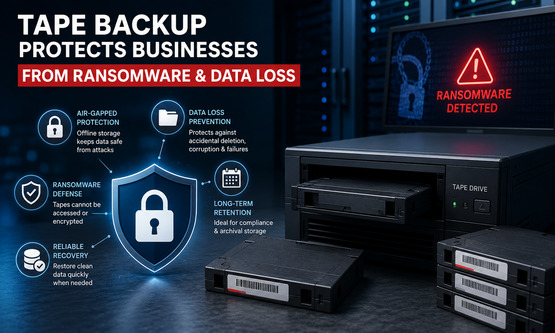
As cyber threats continue to evolve, businesses face increasing risks from ransomware attacks, accidental deletions, hardware failures, and data corruption. For organizations that rely heavily on digital information, losing access to critical data can result in financial losses, operational disruptions, and reputational damage.
While cloud storage and disk-based backups remain important parts of modern IT infrastructure, many organizations continue to depend on tape backup as a reliable layer of protection. Thanks to its offline storage capabilities, long-term reliability, and cost-effectiveness, tape technology remains one of the most trusted solutions for safeguarding business data.
In this article, we’ll explore how tape backup helps businesses defend against ransomware and prevent costly data loss.
Understanding Tape Backup
Tape backup is a data protection method that stores copies of business information on magnetic tape cartridges. These cartridges are read and written using a tape drive, which serves as the primary hardware component of a tape storage system.
Unlike online storage systems that remain connected to networks, tape cartridges can be removed and stored offline. This physical separation provides a powerful security advantage that many organizations use to strengthen their disaster recovery strategies.
Today, tape backup solutions are commonly used in:
- Data centers
- Financial institutions
- Healthcare organizations
- Government agencies
- Educational institutions
- Media and broadcasting companies
The Growing Threat of Ransomware
Ransomware has become one of the most damaging cybersecurity threats facing businesses today.
In a ransomware attack, malicious software encrypts critical files and systems, preventing organizations from accessing their own data. Attackers then demand payment in exchange for a decryption key.
The impact can include:
- Business downtime
- Financial losses
- Lost customer trust
- Regulatory penalties
- Permanent data loss
Many organizations discover that their online backups have also been compromised during an attack because those systems remained connected to the network.
This is where tape backup offers a unique advantage.
Tape Backup Provides Air-Gap Protection
One of the most important reasons businesses continue to use tape technology is its ability to create an air-gapped backup environment.
An air gap means there is no direct network connection between stored backup data and the organization’s production systems.
After data is written to tape using a tape drive, the cartridge can be physically removed and stored securely.
Because the tape is offline:
- Ransomware cannot access it
- Malware cannot infect it
- Hackers cannot encrypt it remotely
- Backup data remains protected during cyber incidents
This offline protection makes tape backup one of the most effective defenses against ransomware attacks.
Reliable Recovery After a Cyberattack
Recovering data quickly after an attack is essential for business continuity.
When online backups become corrupted or encrypted, organizations can restore clean copies of their data from tape.
This allows businesses to:
- Resume operations faster
- Minimize downtime
- Avoid paying ransom demands
- Protect critical information
For many enterprises, tape backup serves as the last line of defense when other recovery methods fail.
Protection Against Accidental Data Loss
Not all data loss is caused by cybercrime.
Businesses frequently experience data loss due to:
- Human error
- Accidental file deletion
- Software failures
- Hardware malfunctions
- System upgrades
- Database corruption
Regular tape backups ensure that historical copies of important information remain available when unexpected issues occur.
By maintaining multiple backup versions, organizations can restore previous data states whenever necessary.
Long-Term Data Retention
Many businesses must retain information for years or even decades.
Industries such as healthcare, finance, legal services, and government often face strict compliance requirements regarding data retention.
Tape storage is particularly well suited for long-term archiving because it offers:
- Stable storage media
- Extended media lifespan
- Low storage costs
- Reliable data preservation
A properly maintained drive tape solution can safely store critical business information for extended periods without requiring continuous power consumption.
Tape Backup Reduces Storage Costs
Cost remains one of the biggest advantages of tape technology.
Compared to many online storage solutions, tape offers:
- Lower cost per terabyte
- Reduced energy consumption
- Minimal maintenance requirements
- Lower long-term storage expenses
Organizations managing large archives can significantly reduce storage costs by incorporating tape backup into their infrastructure.
For enterprises handling petabytes of data, these savings can be substantial.
Modern Tape Drives Offer High Performance
Many people mistakenly believe tape technology is outdated.
In reality, modern tape drive systems provide impressive storage capacity and performance.
Current LTO generations offer:
| Technology | Native Capacity |
|---|---|
| LTO 7 | 6 TB |
| LTO 8 | 12 TB |
| LTO 9 | 18 TB |
These capacities make tape storage suitable for:
- Enterprise backups
- Large-scale archives
- Disaster recovery planning
- Compliance-driven data retention
As data volumes continue to grow, tape remains a scalable storage solution for businesses of all sizes.
Tape Backup and Cloud Storage Work Together
Many organizations view tape and cloud storage as competing technologies, but they often work best together.
A modern backup strategy may include:
Cloud Storage
For accessibility and collaboration.
Disk Storage
For fast operational recovery.
Tape Backup
For long-term retention and ransomware protection.
This layered approach helps organizations balance performance, security, and cost while improving overall resilience.
Industries That Benefit Most from Tape Backup
Several industries continue to rely heavily on tape technology.
Financial Services
Secure retention of transaction records and compliance data.
Healthcare
Protection of patient records and medical imaging archives.
Government Agencies
Long-term preservation of critical public information.
Media and Entertainment
Archiving large video and audio files.
Enterprise Data Centers
Large-scale backup and disaster recovery operations.
These industries trust tape backup because it delivers dependable protection for valuable business information.
Why Businesses Still Invest in Tape Backup
Despite advancements in cloud and disk storage, tape technology continues to provide several unique benefits:
- Offline ransomware protection
- Reliable disaster recovery
- Long-term data retention
- Low storage costs
- High storage capacity
- Regulatory compliance support
- Energy-efficient storage
Few technologies offer the same combination of security, affordability, and reliability.
Final Thoughts
As ransomware attacks and data loss incidents continue to rise, businesses need backup solutions that provide genuine protection against evolving threats. This is why tape backup remains an essential component of many enterprise data protection strategies.
By using a reliable tape drive and maintaining secure drive tape archives, organizations can protect critical information, improve disaster recovery readiness, and reduce the risk of permanent data loss.
At KSG Automation, we continue to see businesses across multiple industries investing in modern tape backup solutions to strengthen cybersecurity, meet compliance requirements, and ensure long-term data protection. For organizations seeking a proven defense against ransomware and data loss, tape backup remains one of the most trusted solutions available today.