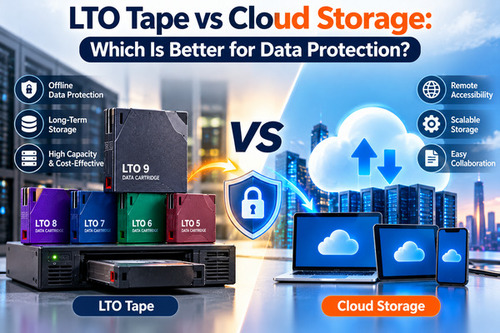
Businesses generate large volumes of digital information every day, including customer records, financial documents, databases, applications, emails, and operational files. Choosing the right storage technology is essential for protecting this information, and lto 9 tape can be an important option for organizations that need high-capacity, offline, and long-term data protection. Cloud storage is another popular approach that provides remote accessibility and flexible capacity. Understanding how these technologies differ can help businesses build a practical and reliable data-protection strategy.
What Is LTO Tape Storage?
LTO, or Linear Tape-Open, is a magnetic storage technology used for enterprise backup, archival storage, disaster recovery, and long-term data retention. An LTO environment generally consists of compatible tape drives, cartridges, backup software, and appropriate storage procedures.
One of the major advantages of LTO technology is that cartridges can be removed from active systems after a backup operation. This physical separation allows organizations to maintain offline copies of important information and store them securely according to their retention requirements.
For businesses operating newer LTO infrastructure, lto 9 tape can provide a high-capacity storage option for large datasets. Organizations should always verify compatibility between the cartridge generation and their existing tape hardware before purchasing media.
What Is Cloud Storage?
Cloud storage allows businesses to store digital information on remote infrastructure managed by a cloud provider. Data can generally be accessed through authorized applications, platforms, or services, depending on the provider and configuration.
One of the biggest benefits of cloud storage is accessibility. Employees and authorized users can access information from different locations, making cloud technology useful for distributed teams and organizations with multiple offices.
Cloud storage can also provide flexible capacity. However, businesses should evaluate recurring costs, internet connectivity, access controls, encryption, provider policies, compliance requirements, and recovery procedures before selecting a cloud-storage platform.
LTO Tape vs Cloud Storage: What Is the Difference?
LTO tape and cloud storage use fundamentally different approaches to data protection. Tape relies on removable physical media, while cloud storage uses remotely managed infrastructure that is generally accessed through a network connection.
LTO can be particularly useful for organizations that need long-term archival copies, offline protection, and storage for large volumes of information. Cloud storage can be attractive for businesses that prioritize accessibility, flexible capacity, automated processes, and remote recovery.
The better choice depends on how frequently data must be accessed, how long it needs to be retained, and what security and recovery requirements the organization has.
Why Is LTO Tape Useful for Long-Term Data Protection?
Long-term data retention can be challenging when organizations continuously generate new information. Tape can provide a practical way to maintain historical copies without keeping every backup connected to the production environment.
A properly managed tape library can contain different backup sets according to daily, weekly, monthly, or yearly retention schedules. Cartridges can also be moved to secure locations for disaster-recovery or archival purposes.
Organizations with established LTO 6 infrastructure may continue using lto 6 tape for compatible backup and archival applications. Before deployment, businesses should confirm the supported media generation and capabilities of their existing drive.
How Does Cloud Storage Handle Data Security?
Cloud providers may offer several security capabilities, including encryption, authentication, access management, monitoring, and permission controls. These features can help organizations protect stored information when they are configured and managed correctly.
However, security is not determined by the storage location alone. Businesses should establish strong passwords, appropriate permissions, multi-factor authentication where available, encryption policies, and procedures for monitoring access.
For organizations using compatible LTO 6 environments, HP lto 6 tape can provide removable media for backup and archival requirements. Physical media should also be protected through controlled access and suitable storage conditions.
What Role Does an LTO Data Cartridge Play?
An LTO data cartridge is the physical medium used to store digital information in an LTO environment. Different generations have different specifications, so businesses must select cartridges that are supported by their tape drives.
For compatible LTO 8 systems, an HP lto 8 Data Cartridge can be used for appropriate backup and archival requirements. Businesses should maintain accurate media inventories, clear cartridge labels, and suitable storage conditions to make tape management more efficient.
Proper handling is particularly important when cartridges are expected to remain in storage for extended periods.
Can Older LTO Media Still Be Used?
Many organizations continue to operate previous-generation tape infrastructure because their existing systems remain useful for specific backup and archival workloads. Older media can therefore continue to have value when used with compatible equipment.
For example, an HP lto 5 Data Cartridge can be relevant to organizations maintaining compatible LTO 5 infrastructure. Before using older media, businesses should verify the read and write capabilities of their particular tape drive.
Compatibility between the cartridge, drive, backup software, and operating environment is essential for dependable data recovery.
What Is a Magnetic Tape Drive?
A magnetic tape drive is a hardware device that reads and writes digital information to magnetic tape media. It acts as the connection between the backup system and the physical cartridge.
Businesses selecting tape hardware should consider supported media generations, storage capacity, transfer performance, connectivity, encryption capabilities, backup-software compatibility, and scalability.
A magnetic tape drive can be particularly useful for organizations that need to manage large quantities of information that does not require constant access.
Businesses can also learn more about tape capacity and compression by referring to LTO-9 Tape Capacity and Compression: How Much Data Can You Really Store? as part of their research into high-capacity tape storage.
Which Is More Cost-Effective: LTO Tape or Cloud?
The overall cost of a storage solution depends on data volume, retention requirements, access frequency, infrastructure, maintenance, and recovery needs. Cloud storage commonly involves recurring subscription or usage-based costs, which may increase as storage requirements grow.
Tape can involve an initial investment in drives and infrastructure, followed by media and maintenance expenses. For information that does not need frequent access, physical tape can provide an economical option for long-term retention.
Businesses should therefore compare total cost of ownership instead of considering only the initial storage price. Network usage, cloud subscriptions, hardware, media, administration, migration, and recovery can all affect the final cost.
Which Storage Option Is Better for Data Protection?
There is no universal answer because every organization has different requirements. Cloud storage can be useful when remote access, scalability, and frequent recovery are important priorities.
LTO technology can be valuable when businesses require offline copies, physical media control, long-term archival, and protection for large datasets. A hybrid strategy can combine both technologies to address different storage requirements.
For example, frequently accessed information can remain on cloud or disk-based infrastructure, while selected long-term backup copies can be retained on physical tape.
Best Practices for Business Data Protection
Businesses should follow a structured backup strategy regardless of which storage technology they choose. Important practices include maintaining multiple copies of critical information, testing recovery procedures, controlling access, encrypting sensitive data, monitoring backup operations, and documenting retention policies.
Organizations using tape should maintain accurate cartridge inventories and ensure that media is stored in appropriate conditions. Cloud users should regularly review permissions, authentication settings, encryption configurations, provider policies, and recovery options.
Using more than one storage technology can provide additional resilience and reduce dependence on a single environment.
Choosing the Right Solution for Your Business
The right storage strategy depends on the organization’s data volume, recovery objectives, retention period, security requirements, accessibility needs, and budget.
Businesses with large archives may benefit from removable media and structured tape retention, while organizations that need frequent remote access may prefer cloud infrastructure. A combination can often provide a practical balance between accessibility and long-term protection.
KSG Automation Pvt. Ltd. supports businesses evaluating storage, backup, tape media, and related IT infrastructure based on their specific requirements.
Conclusion
LTO tape and cloud storage both have an important role in modern data protection, but they are designed around different priorities. Cloud storage focuses on remote accessibility, scalability, and flexible management, while LTO technology provides removable media, offline storage, and long-term archival capabilities.
Organizations using compatible LTO environments can consider options such as lto 9 tape, lto 6 tape, HP lto 6 tape, HP lto 8 Data Cartridge, and HP lto 5 Data Cartridge according to their infrastructure requirements. Businesses should always verify compatibility, capacity, security features, recovery objectives, and total cost before selecting a solution.
For organizations evaluating tape and cloud storage for their data-protection strategy, Contact Us to discuss your specific backup, archival, and storage requirements.