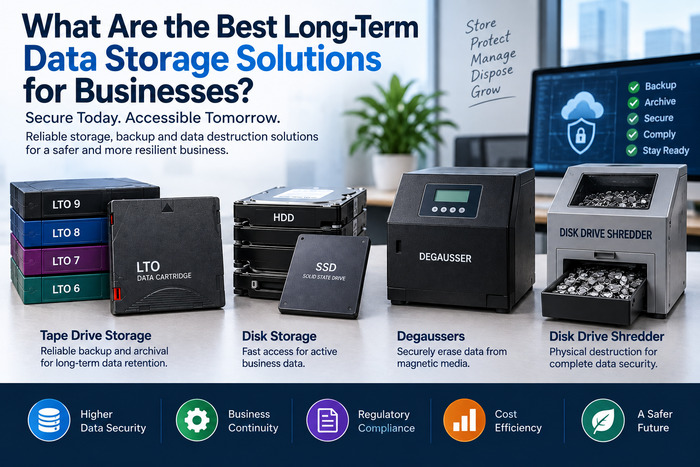
Businesses generate and store enormous amounts of digital information, including customer records, financial documents, databases, applications, project files, and operational data. Choosing reliable tape drive storage can help organizations maintain secure, durable, and cost-effective access to important information over extended periods. Long-term data management also requires businesses to consider backup, archival, recovery, data security, compliance, and secure disposal. KSG Automation Pvt. Ltd. provides data-storage and IT infrastructure solutions that can support businesses in managing different stages of the data lifecycle.
Why Is Long-Term Data Storage Important for Businesses?
Data is one of the most valuable assets for modern organizations. Business information may need to be retained for several years because of operational requirements, historical records, regulatory obligations, customer needs, or disaster recovery planning.
A suitable long-term storage strategy should provide adequate capacity while protecting information against accidental deletion, hardware failure, cyber threats, physical damage, and other risks. Businesses should also consider how quickly archived information needs to be accessed and how long it must be retained.
What Is Tape Drive Storage?
Tape drive storage is a data-storage technology that uses magnetic tape cartridges to write, store, and retrieve digital information. It is widely associated with backup and archival applications where organizations need reliable storage for large amounts of data over long periods.
Tape-based storage can be useful for creating backup copies that are separated from everyday IT systems. Organizations can maintain stored cartridges for disaster recovery, business continuity, regulatory retention, and historical data preservation.
Businesses interested in understanding how this technology operates can also refer to What Is an LTO Tape Drive and How Does It Work? This resource explains the basic working principles of LTO tape drives and how tape media is used for business data storage and backup.
Why Is Tape Suitable for Long-Term Data Retention?
Tape has several characteristics that make it useful for long-term data management. Unlike constantly connected storage, removable tape cartridges can be stored separately from production systems when they are not being accessed.
This can create an additional layer in a business’s backup strategy. Tape can also support large-scale data archiving, allowing organizations to retain information without keeping every archived dataset on primary storage systems.
For businesses managing large volumes of information, KSG Automation Pvt. Ltd. offers storage-related products and solutions designed around different business infrastructure requirements.
Is Disk Storage Suitable for Long-Term Data?
Disk-based storage remains important for businesses that need fast access to frequently used data. Hard disk drives and other disk-based systems are commonly used for operating applications, databases, file servers, and active backups.
However, active disk storage is not always the only requirement for long-term retention. Businesses may combine disk storage with other technologies to create multiple copies of important information.
A practical approach is to use fast storage for frequently accessed data while maintaining separate backup or archival media for information that does not need constant access.
What Are Degaussers and How Do They Help?
When organizations retire magnetic storage media, simply deleting files may not provide sufficient protection for sensitive information. Degaussers are specialized devices designed to erase data from compatible magnetic media by applying a strong magnetic field.
Businesses can use degaussing as part of a secure media-disposal process when magnetic storage devices or tapes reach the end of their useful life. This can help reduce the risk of sensitive information remaining recoverable on retired media.
Degaussing should be performed according to the requirements of the specific storage medium and the organization’s data-security procedures.
What Is a Disk Drive Shredder?
A disk drive shredder is designed to physically destroy storage drives so that the information stored on the drive becomes inaccessible through normal recovery methods.
Physical destruction can be useful when organizations need to permanently dispose of retired hard drives or other suitable storage devices containing confidential information. It can form part of an end-of-life data-security process alongside inventory management, secure handling, and disposal documentation.
For businesses dealing with sensitive customer, financial, employee, or proprietary information, secure media destruction can be an important part of overall information-security management.
Comparing Long-Term Data Storage Options
Different technologies serve different purposes, so businesses should select storage based on their operational and security requirements.
- Tape drive storage: Suitable for backup, archival, disaster recovery, and long-term data retention.
- Disk storage: Useful when businesses require fast and regular access to active data.
- Cloud storage: Can provide scalable remote storage and convenient access, depending on the selected service and security configuration.
- Degaussers: Useful for securely erasing compatible magnetic storage media before disposal or reuse.
- Disk drive shredder: Suitable for physical destruction of storage drives when permanent disposal is required.
Many organizations can benefit from using multiple technologies rather than depending on a single storage method.
How Should Businesses Choose a Long-Term Storage Solution?
Before selecting a storage solution, organizations should evaluate several factors:
1. Data Volume
Estimate current storage requirements and expected future growth. A scalable solution can help businesses manage increasing data volumes more efficiently.
2. Retention Period
Determine how long different types of information must be retained. Some business records may need short-term backup, while others may require years of archival storage.
3. Security Requirements
Sensitive information requires appropriate protection throughout its lifecycle. Businesses should consider encryption, access controls, offline backups, physical security, and secure disposal.
4. Accessibility
Consider how frequently archived information needs to be retrieved. Frequently accessed data may require faster storage, while rarely accessed information can be placed in an archival system.
5. Disaster Recovery
A long-term storage strategy should account for hardware failures, ransomware, accidental deletion, natural disasters, and other events that could affect primary systems.
6. Data Disposal
Storage planning should not end when media reaches the end of its useful life. Organizations should establish procedures for securely erasing or physically destroying retired storage devices.
Building a Complete Data Storage Strategy
An effective business data strategy can combine primary storage, backup systems, archival media, and secure disposal processes. For example, frequently used information can remain on disk-based infrastructure, while backup copies can be maintained on removable media or other suitable platforms.
Organizations can also establish retention policies that define which information should be archived, how long it should be retained, where it should be stored, and how it should eventually be destroyed.
KSG Automation Pvt. Ltd. provides products and solutions across storage, backup media, tape drives, data security, and data-destruction requirements, helping organizations consider different technologies as part of their broader IT infrastructure.
Final Thoughts
Choosing the right long-term data storage solution depends on data volume, retention requirements, accessibility, security, budget, and business continuity needs. Tape drive storage can support long-term backup and archival requirements, while degaussers and a disk drive shredder can help organizations manage the secure end-of-life disposal of suitable storage media.
Rather than relying on one technology, businesses can develop a layered approach that combines active storage, backup, archival, recovery, and secure data destruction. For reliable storage, backup, and data-management solutions tailored to your business requirements, Contact Us KSG Automation Pvt. Ltd. to explore suitable options for your organization’s data lifecycle.