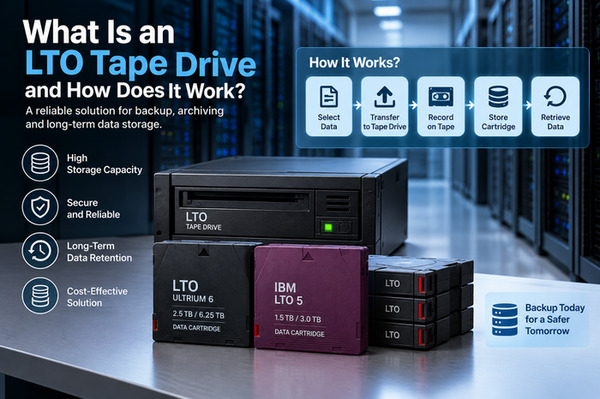
As businesses continue to generate large volumes of digital information, reliable data storage and backup have become essential for maintaining business continuity. An lto tape drive is a specialized storage device that helps organizations write, read, and preserve data on magnetic tape cartridges. LTO technology is widely used for enterprise backup, data archiving, disaster recovery, and long-term data retention. With suitable media and a well-planned backup strategy, businesses can create additional copies of critical information while supporting scalable storage requirements.
What Is an LTO Tape Drive?
An LTO tape drive is a data-storage device based on Linear Tape-Open technology. It reads and writes digital information on compatible LTO data cartridges using magnetic tape. Unlike hard disk drives and solid-state drives, tape uses sequential access, making it particularly suitable for backup and archival workloads where large amounts of information need to be stored for extended periods.
The drive acts as the connection between a computer, server, or backup system and the tape cartridge. Backup software sends selected information to the drive, which records the data onto the magnetic tape. When the information is required, the drive reads the stored data and transfers it back to the connected system.
How Does an LTO Tape Drive Work?
The operation of an LTO tape system can be explained through several straightforward steps:
1. Data Selection
Backup software identifies the files, databases, applications, or systems that need protection. Businesses can configure backup schedules based on their operational requirements and recovery objectives.
2. Data Transfer
The selected information is transferred from a server or storage environment to the tape hardware. The actual transfer performance depends on the tape generation, system configuration, data type, and overall infrastructure.
3. Data Recording
The device records information magnetically onto the tape inside a compatible cartridge. The data is organized so it can be identified and restored when necessary.
4. Cartridge Storage
After the backup is completed, the cartridge can be removed from the system and stored securely. Keeping selected media offline can provide an additional layer of protection for important business information.
5. Data Recovery
When a business needs to recover information, the cartridge is loaded into compatible hardware. Backup software can then locate the required files or data and restore them to the appropriate system.
Why Do Businesses Use LTO Tape Technology?
LTO technology remains relevant because organizations continue to generate significant amounts of data that may need to be retained for months or years. Tape provides removable storage that can support enterprise backup, archival requirements, disaster recovery, and long-term data retention.
One important advantage is the ability to separate backup media from continuously connected systems. After a cartridge is removed and securely stored, it is no longer continuously connected to the production network. This can be useful as part of a broader data protection strategy.
Other potential advantages include high storage capacity, portability, scalability, long-term retention, and cost-effective storage for large archives. KSG Automation Pvt. Ltd. provides tape-storage products and related IT solutions that can help organizations evaluate suitable options according to their infrastructure and business requirements.
What Is LTO 6 Tape?
lto 6 tape is a generation of LTO magnetic media designed for compatible LTO 6 drives. It can be used to store backup data, archived files, databases, and other large datasets.
LTO 6 provides organizations with a removable storage option that can be useful for businesses with existing compatible infrastructure. Before purchasing or deploying media, organizations should confirm compatibility between the cartridge generation, tape hardware, backup software, and operating environment.
Businesses using older LTO infrastructure may continue to use LTO 6 media where it meets their capacity, performance, and retention requirements. Organizations planning an upgrade can also compare their current needs with newer LTO generations.
What Is IBM LTO 5 Tape?
IBM lto 5 tape is magnetic tape media designed for compatible LTO 5 drives and is associated with enterprise backup, archival, and data-retention applications. LTO 5 technology provides businesses with removable media for storing information outside their primary online storage environment.
When working with an older LTO generation, compatibility is particularly important. Businesses should verify that their drive supports the required media generation and that their backup application is correctly configured.
Organizations with legacy systems may continue to use compatible LTO 5 media when it satisfies their existing storage and retention requirements.
What Is an IBM LTO 5 Data Cartridge?
An IBM lto 5 Data Cartridge is a removable magnetic storage medium designed for use with compatible LTO 5 tape drives. It stores digital information that can be written, retained, and retrieved through appropriate hardware and backup software.
Data cartridges can be labeled and organized according to backup dates, departments, projects, retention periods, or other business requirements. Proper media management helps IT teams identify specific backup sets when information needs to be restored.
Before deploying an IBM lto 5 Data Cartridge, businesses should verify drive compatibility, media condition, storage environment, and the organization’s backup and retention policy.
What Are the Main Uses of LTO Tape Drives?
LTO systems are used across many business and enterprise environments. Common applications include:
- Enterprise data backup
- Long-term data archiving
- Disaster recovery
- Business continuity planning
- Data retention
- Compliance-related storage
- Large-scale media storage
- Offline backup protection
Tape is particularly useful when information does not need to remain online but must still be preserved for future access. Organizations can maintain cartridges according to specific retention schedules and recovery requirements.
How Does LTO Tape Support Data Protection?
A strong backup strategy should maintain more than one copy of critical information. Tape can serve as an additional storage layer alongside disk and cloud-based backup systems.
For example, frequently accessed information may remain on primary storage, recent backup copies may be maintained on disk or cloud infrastructure, and selected long-term copies can be stored on removable cartridges. This layered approach gives businesses greater flexibility when designing their recovery strategy.
Because tape media can be removed from the production environment, organizations can maintain selected copies separately from continuously connected systems. Secure offsite storage can provide another layer of protection and support disaster recovery planning.
For a broader explanation of tape-based data protection, What Is Tape Backup and Why Is It Important for Data Protection? explains the role of offline storage, LTO technology, backup strategies, disaster recovery, and long-term data retention.
What Should You Consider Before Choosing an LTO Tape Drive?
Businesses should evaluate several factors before selecting tape-storage hardware.
Compatibility
Check compatibility between the drive, cartridge generation, backup software, operating system, and server environment.
Capacity
Estimate current data volume and future growth. The selected solution should support regular backups as well as long-term retention.
Performance
Consider transfer performance and whether the surrounding server, network, and storage infrastructure can support the required backup workload.
Security
Evaluate encryption capabilities, access controls, physical media security, and secure storage procedures for sensitive information.
Retention
Determine how long backup media needs to be preserved and create a suitable rotation and storage policy.
Recovery Requirements
Consider how quickly different categories of information need to be restored. Tape is highly useful for archival and disaster recovery, while frequently accessed information may require additional online storage.
How Should LTO Cartridges Be Stored?
Proper media storage is essential for maintaining the reliability of magnetic tape. Cartridges should be kept in a clean, secure, and controlled environment and protected from excessive heat, moisture, dust, physical damage, and unsuitable storage conditions.
Businesses should maintain an accurate cartridge inventory with labels identifying the backup set, date, retention period, and other relevant details. Regular restoration testing is also important because a backup should be verified rather than simply created and forgotten.
Why Is LTO Still Relevant for Modern Businesses?
The continuous growth of digital information means organizations need storage solutions that can accommodate large datasets and long retention periods. LTO technology provides removable media that can complement cloud and disk-based storage.
For businesses with existing compatible infrastructure, lto 6 tape can remain useful for specific backup and archival requirements. Similarly, IBM lto 5 tape can continue to serve legacy environments when compatibility and business requirements support its use.
Organizations should select media and hardware based on their actual infrastructure rather than choosing a tape generation solely on capacity.
Conclusion
An LTO tape drive provides businesses with a reliable method of writing, reading, backing up, and archiving information on compatible magnetic tape cartridges. LTO technology can support enterprise backup, disaster recovery, offline storage, and long-term data retention.
Businesses using legacy infrastructure can evaluate IBM lto 5 Data Cartridge solutions alongside compatible hardware, while organizations using LTO 6 environments can consider their existing media and future storage requirements. The right solution should always be selected according to compatibility, capacity, performance, security, retention, and recovery objectives.
With proper media management, secure storage, regular backups, and restoration testing, LTO technology can remain a valuable component of a modern data protection strategy. For reliable tape-storage, data backup, and enterprise IT solutions, Contact Us at KSG Automation Pvt. Ltd. to discuss your requirements and explore suitable storage options.