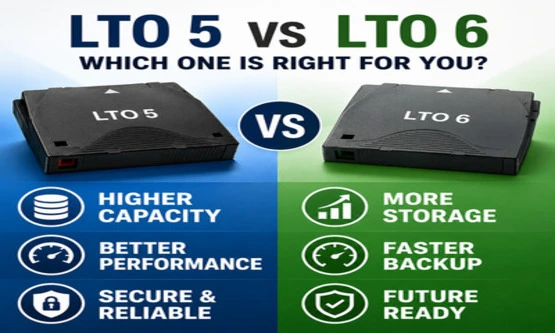
As businesses continue to rely on secure and cost-effective data storage, tape technology remains a trusted solution for long-term backup and archival. Among older but still widely used generations, LTO 5 tape and LTO 6 tape are commonly compared by organizations managing legacy systems or looking for budget-friendly storage options.
In this guide, we break down the key differences between LTO 5 and LTO 6 to help you choose the right solution for your business.
What is LTO Tape Technology?
LTO (Linear Tape-Open) is a magnetic tape storage format used for:
- Enterprise data backup
- Long-term data archiving
- Disaster recovery
It is known for its durability, reliability, and low cost per GB, making it ideal for businesses handling large volumes of data.
LTO 5 vs LTO 6: Key Differences
| Feature | LTO 5 Tape | LTO 6 Tape |
|---|---|---|
| Native Capacity | 1.5 TB | 2.5 TB |
| Compressed Capacity | 3 TB | 6.25 TB |
| Transfer Speed | 140 MB/s | 160 MB/s |
| Backward Compatibility | Reads/Writes LTO 4 | Reads/Writes LTO 5 |
| Encryption | AES 256-bit | AES 256-bit |
| Ideal Use | Small businesses | Small to mid businesses |
Storage Capacity Comparison
LTO 6 offers a noticeable improvement in storage capacity over LTO 5.
- LTO 5: 1.5 TB native capacity
- LTO 6: 2.5 TB native capacity
This allows businesses to store more data on fewer cartridges, reducing operational complexity.
Performance and Speed
When it comes to performance:
- LTO 5: up to 140 MB/s
- LTO 6: up to 160 MB/s
While the speed difference is not massive, LTO 6 still provides better efficiency for regular backup operations.
Compatibility and Upgrade Path
Compatibility plays an important role when upgrading tape infrastructure.
- LTO 5 drives can read and write LTO 4 tapes
- LTO 6 drives can read and write LTO 5 tapes
This makes LTO 6 a logical upgrade path for organizations currently using LTO 5 systems.
Use Case Analysis
When to Choose LTO 5
- You are maintaining legacy backup systems
- Your data storage needs are minimal
- You are working with a limited budget
When to Choose LTO 6
- You need higher storage capacity
- You want improved performance
- You are planning gradual system upgrades
Cost vs Value
LTO 5 is typically more affordable and may be suitable for basic archival needs. However, LTO 6 offers:
- Better storage efficiency
- Improved performance
- More future-ready capability
For businesses expecting data growth, LTO 6 is generally the more practical investment.
Data Security and Reliability
Both LTO 5 and LTO 6 support:
- AES 256-bit encryption
- WORM (Write Once Read Many) functionality
These features ensure data protection and compliance for long-term storage.
Available LTO Tape Options
Businesses can explore a range of LTO 5 and LTO 6 tape cartridges depending on their backup requirements. At KSG Automation, multiple options are available to support legacy and modern storage environments.
Choosing the right tape depends on your infrastructure, storage volume, and long-term planning.
Frequently Asked Questions
What is the main difference between LTO 5 and LTO 6?
The main difference is capacity and performance. LTO 6 offers higher storage capacity and slightly better speed compared to LTO 5.
Is LTO 6 backward compatible?
Yes, LTO 6 drives can read and write LTO 5 tapes.
Is LTO 5 still used?
Yes, LTO 5 is still used in legacy systems and environments with limited storage requirements.
Which option is better for upgrading?
LTO 6 is the better choice for upgrading due to its improved capacity and compatibility.
Final Recommendation
Both LTO 5 and LTO 6 are reliable tape storage solutions designed for different business needs.
LTO 5 is suitable for organizations maintaining legacy systems or working with limited data.
LTO 6 is a more advanced option, offering better capacity, performance, and scalability.
Choosing the right solution depends on your current infrastructure and future storage requirements.
For businesses planning upgrades or new implementations, consulting with experts like KSG Automation can help in selecting the most suitable backup solution.