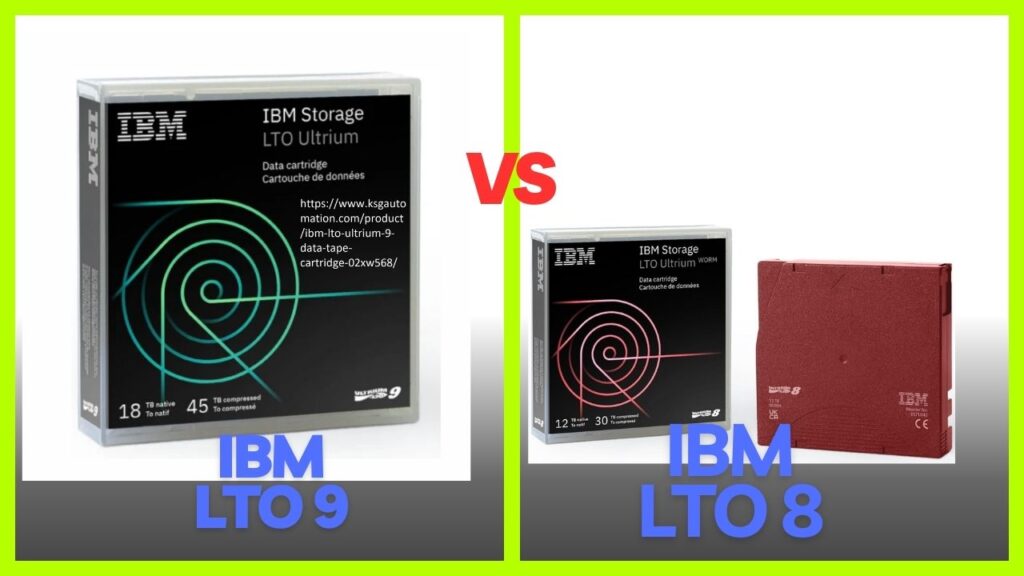
Tape cartridges are still safe in the world of data storage. They are economical, long-lasting, and perfect for long-term archiving. LTO (Linear Tape-Open) is one of the modern forms of tape. Two generations in this line today are compared: IBM LTO-9 and LTO-8. Let’s describe their major differences and the reason why most organisations are upgrading.
What Are LTO-8 and LTO-9?
LTO-8 and LTO-9 are tape cartridge generations that are used in the backup and storage of vast volumes of data. The number is used to identify the generation –the higher the number, the newer the technology and the better the capacity and performance. LTO-9 is the most recent generation of LTO that is available widely.
IBM manufactures strong LTO-9 cartridges that meet the requirements of the current enterprise. These cartridges offer better performance and storage capacity than LTO-8.
Storage Capacity: A Big Boost
Storage capacity is one of the largest differences between LTO-9 and LTO-8.
- LTO-8 has an approximate native (uncompressed) and compressed capacity of 12 TB and 30 TB, respectively, in a single cartridge.
- This is raised to about 18 TB native and 45 TB compressed by LTO-9.
That is approximately a 50% increase in storage in LTO-9 over LTO-8. Organisations can also store as much data in a few cartridges. That will save physical storage space, ease managing tapes, and save in the long term.
This expansion is most important in the contexts where huge volumes of archived data accumulate rapidly. LTO-9 will satisfy such increasing requirements without swapping tapes regularly.
Faster Data Transfer
In addition to capacity, there is speed. The speed of the tape drives will guarantee faster backups and restores. LTO-9 increases the transfer speeds when compared to LTO-8.
- The native and maximum compressed data transfer rate of LTO-8 is approximately 360 MB/s and 900MB/s, respectively.
- LTO-9 is up with approximately 400 MB/s native and up to 1,000 MB/s compressed.
This is an increase in performance that ensures that backups and restores occur within a shorter duration. Minimised downtime is essential to companies with limited backup slots and large volumes of data.
Security and Data Protection
LTO-8 and LTO-9 are both hardware-based encryption. This safeguards delicate information throughout storage and transportation. Nonetheless, LTO-9 also introduces more advanced security features that are more in line with the current compliance requirements.
Encryption at a high level, like AES 256-bit, prevents the data stored in archives from falling into the wrong hands. Data protection policies and regulations can be achieved with the assistance of secure tape storage.
One more significant attribute is WORM (Write Once, Read Many). It does not allow any alteration of data after it is written. LTO-9 is compatible with WORM, which makes it a perfect choice to use in regulated industries in their retention policies.
Compatibility and Ease of Upgrade
The issue of compatibility with the existing systems is one of the concerns when upgrading the technology. LTO-9, in this case, has something to reassure you.
Migration becomes easier between LTO-9 and LTO-8 cartridges because an LTO-9 drive is able to read and write LTO-8 cartridges. As organisations move to the next generation, they can continue using the available tape libraries.
This backward compatibility saves on risk and cost. You do not need to substitute all your tapes at once. In its place, LTO-9 can be introduced slowly, keeping the older backups available.
Durability and Lifespan
Tape cartridges are constructed to last long. Both the LTO-8 and LTO-9 are intended to last decades. Particularly, LTO-9 media is capable of long-term storage of vital data, where anticipated archival life is in the decades. This renders them suitable for archives which need to withstand a change of hardware and be able to be read in the long run.
Cyberattacks are also not very strong against tape storage. Offline “air-gapped” tape storage implies that data are not physically connected to networks. This secures against ransomware and other cyber threats to the online resources.
Why Upgrade from LTO-8 to LTO-9?
So, why should businesses upgrade?
- Increased Storage Capacity and Reduced Cartridges
LTO-9 reduces the number of cartridges required owing to its increased capacity. This simplifies the tape libraries and reduces costs to store the physical data.
- Faster Backups
Thanks to the increased speed of transfer, backup windows reduce in size. Faster writes and reads enhance operations.
- Future-Ready Security
Enhanced protection and WORM assistance are useful in achieving changing data protection standards in industries.
- Smoother Transition
LTO-8 drive backward compatibility allows organisations to get upgraded gradually.
- Cost-Effective Over Time
Even though LTO-9 media might be a little more expensive per cartridge, the advantages and efficiency of the storage can be more than the cost. In the long run, reduced cartridges and increased speed of workflow save money.
Conclusion
LTO tape technology has continued to serve as a foundation of accessible, new, scalable backup and archive solutions. Also, the advantages are obvious when it comes to comparing IBM LTO-9 data cartridges with LTO-8. LTO-9 has increased capacity, improved performance, increased security, and compatibility benefits that would enable organisations to fulfil future needs.
Turning to LTO-9 upgrades, no matter whether you are running enterprise data centres or are protecting important archives, you will find your organisation in a better position to deal with expansion, secure information better, and simplify the backup process.
Ready to make the move? LTO-9 gives your storage plan the power to store data in the most current capacity, at high speed and with high security over the coming years.